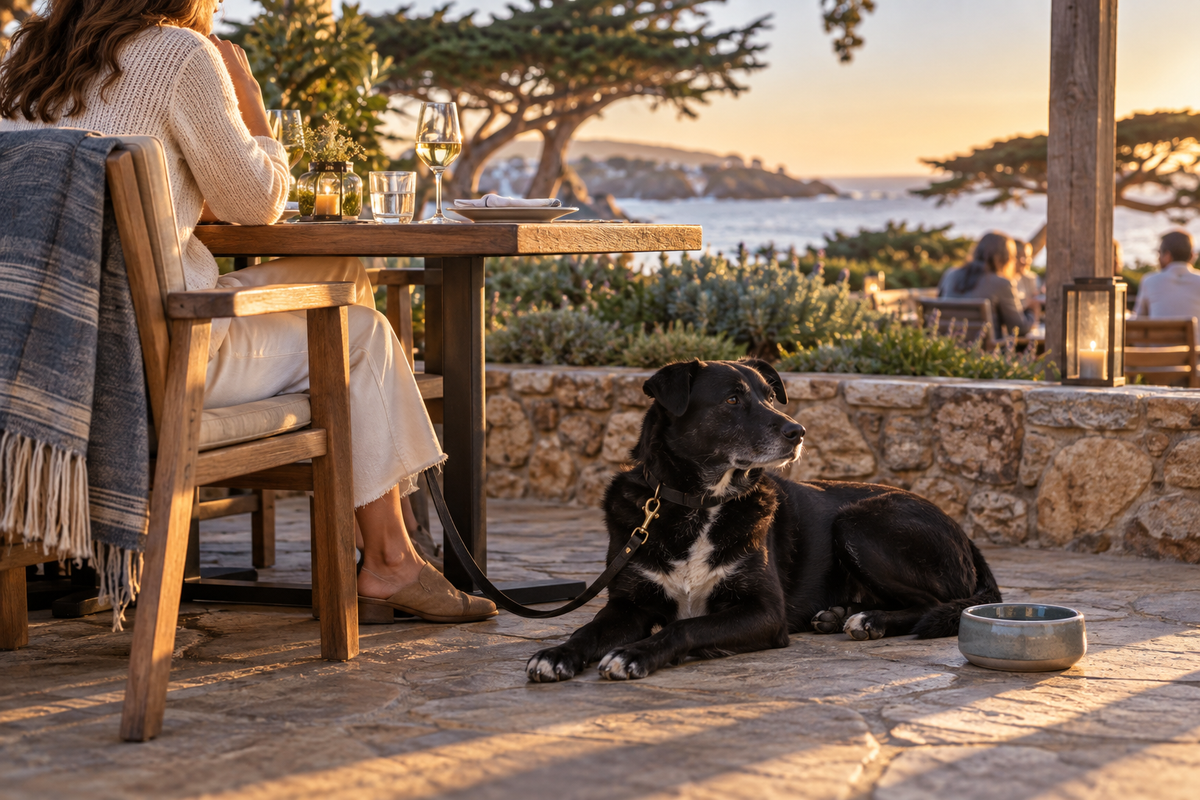
California law can permit pet dogs in some outdoor dining areas—but the business still decides, and a legal patio is not automatically the right place for every dog.
Yes, pet dogs may be allowed on a California restaurant patio when the operator chooses to allow them and the outdoor area meets state and local requirements. It is not a blanket right to enter every patio. The dog must remain leashed or in a carrier and under control, and the kind choice is to go only when that particular dog can settle comfortably in the space.
That distinction matters around Monterey Bay today. SPCA Monterey County lists Dog Bar at Carmel Mission Inn from 5–8 p.m. on October 6, with live music beginning at 6 p.m.; the outdoor event is canceled if it rains. It is a useful reminder that “dog-friendly” describes access. It does not tell you whether the setting is a good match for your dog.
What does California law allow?
California Health and Safety Code section 114259.5 allows a food facility to permit pet dogs in an outdoor dining area when specific conditions are met. The restaurant must elect to allow them; a customer cannot assume that every outdoor table is pet-friendly.
The law requires a separate outdoor entrance so pet dogs do not pass through the establishment to reach the patio. Dogs cannot be on chairs, benches, seats or other fixtures. They must be leashed or confined in a carrier and remain under the owner’s control. The patio must be kept clean, and food or water supplied to a pet by the business must be served in a single-use disposable container.
Local ordinances and any additional measures approved by the enforcement agency still apply. A restaurant may also set a stricter house policy. The practical rule is simple: confirm the exact patio’s current policy before leaving home, even if a directory or old review calls the business dog-friendly.
These rules concern pet dogs. Trained service animals are addressed separately under disability-access law and should not be treated as ordinary pets.
How can you tell whether your dog wants to be there?
A patio can combine tight table spacing, dropped food, rolling carts, children, unfamiliar dogs, music and servers approaching from several directions. A dog who enjoys a quiet sidewalk table may not enjoy a busy event around open fire pits and live music.
Look for the ability to settle, take in the environment without constantly scanning and recover after a person or dog passes. UC Davis highlights leaning away, sudden tension and a firmly closed mouth as possible signs of discomfort. AAHA’s broader distress list includes panting, trembling, lip licking, yawning, freezing, pacing, hiding, escape attempts and social disengagement.
No single gesture tells the whole story. Watch for clusters, changes and whether the dog can relax again. If the dog becomes increasingly vigilant or tries to leave, leaving is the considerate response—not a failed training exercise.
What should you check before sitting down?
- Permission: Confirm that the exact patio and event allow pet dogs today.
- Access: Identify the direct outdoor entrance and a quick, uncrowded exit.
- Conditions: Check shade, wind, rain, surface temperature, noise and table spacing.
- Control: Use a short, secure leash; keep the dog on the ground and close enough that the leash does not cross a walkway.
- Setup: Choose an edge table when possible, keep food out of reach and give the dog a protected resting spot away from feet and service traffic.
- Exit plan: Be willing to switch to takeout or leave before the dog becomes overwhelmed.
For more California access planning, use the California Dog Guide. For everyday decisions about comfort, behavior and changing plans, visit Life Together and the Dog Help Desk.
When is staying home the better plan?
Skip the patio when the dog is ill, recovering, newly overwhelmed by unfamiliar places, unable to settle around food or dogs, or medically vulnerable to the day’s temperature and conditions. A newly adopted dog may need quieter routines while you learn what comfort looks like. A sudden change in sociability, tolerance or ability to settle deserves veterinary attention rather than being dismissed as stubbornness.
Dog-friendly coastal life is not measured by how many places the dog attends. It is measured by how well we notice what the dog can handle—and how easily we change the plan.
Source note: Event details, California patio requirements and veterinary behavior guidance were checked October 6, 2026. Restaurant policies and event conditions can change; confirm directly before visiting.