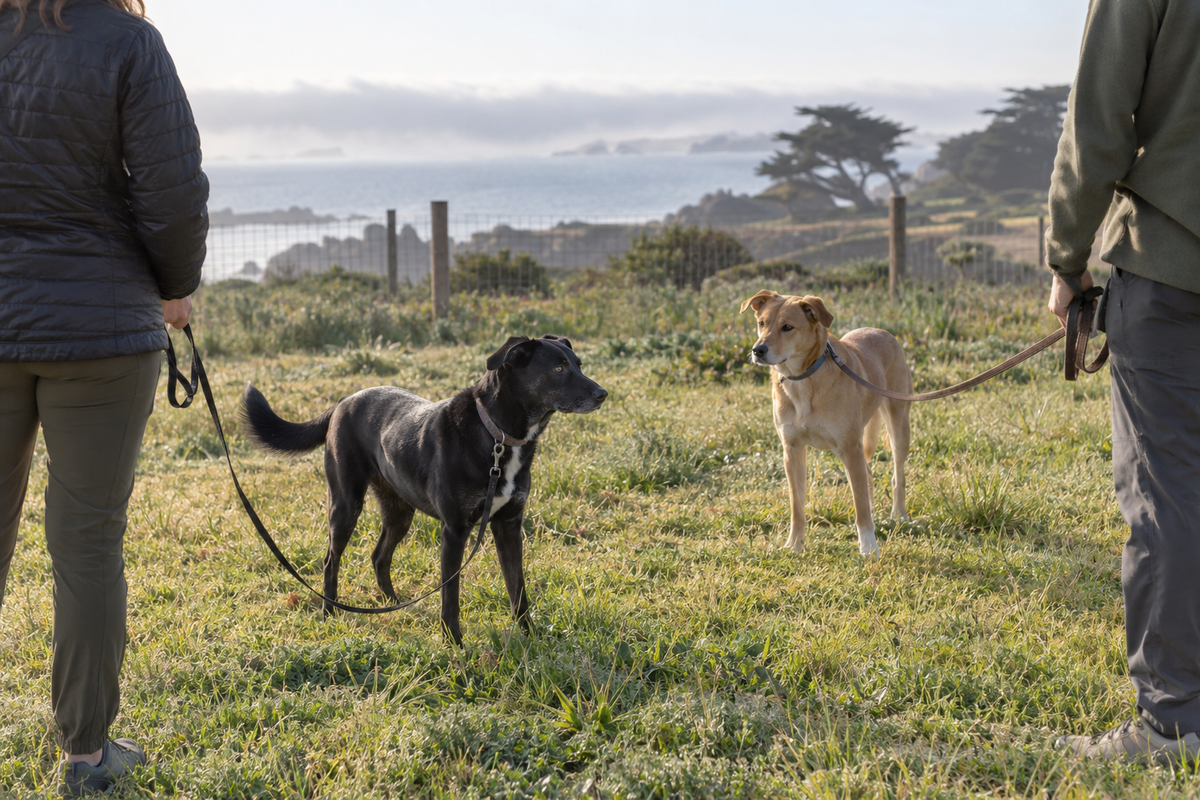
SPCA Monterey County’s Sunday Socials make an important distinction: group play is for dogs who already enjoy it, not a test every dog must pass.
Direct answer: No—your dog does not need to enjoy dog parks or large playgroups to have a full, healthy life. Group play is a good fit only when the dog is comfortable, willingly participates and can take breaks without becoming overwhelmed. A dog who avoids the group, repeatedly tries to leave or shows escalating distress needs distance and a different kind of enrichment, not more pressure.
That is especially worth saying today. SPCA Monterey County is holding its reservation-only Sunday Socials on September 20, describing them as a safer alternative to dog parks for friendly, well-socialized dogs at least nine months old. The organization is equally clear about what the sessions are not: a place to teach a dog how to play or rehabilitate social skills.
That boundary is useful far beyond one Monterey County event. It gives dog people permission to stop treating the dog park as a required milestone.
Socialization does not mean “play with every dog”
People often use socialization as shorthand for wrestling, chasing and greeting every dog in sight. That is not the goal.
In current puppy guidance, the American Animal Hospital Association explains that socialization means helping a dog remain calm and comfortable around people, animals and everyday experiences. A puppy who can notice another dog and stay connected to its person is learning something valuable—even if no greeting happens.
For adult dogs, the same principle is liberating. Neutrality is a successful social skill. Walking past another dog without fear, frustration or compulsory greeting can be more useful in ordinary life than joining a crowded group.
Salt Hound’s Life Together guide is built around this kind of real-life fit: learning the dog in front of you rather than forcing a standard picture of what dog ownership should look like.
How can you tell whether group play fits?
Start with willingness. A suitable dog should be able to enter without being dragged toward the group, move comfortably, disengage and check back in. Healthy interaction includes pauses. If one dog repeatedly tries to create distance while another keeps pursuing, the answer is not to “let them work it out.” It is to interrupt and give both dogs room.
Watch the whole dog, not just the tail. UC Davis veterinary guidance identifies tucked tails, lip licking, yawning, shaking and ears held back as possible signs of stress. AAHA also advises watching for lowered posture, avoiding eye contact, trembling and other changes. One signal needs context; a cluster or repeated attempt to leave is information worth respecting.
If a dog barks, lunges, freezes, guards, panics or has a bite history, skip the experiment and ask a veterinarian or qualified positive-reinforcement behavior professional for an appropriate plan. Salt Hound’s Dog Help Desk can help organize the next questions, but it cannot replace an individual behavioral or medical assessment.
What about a newly adopted dog?
A dog’s first days in a new home are not a fair audition for the dog park.
Ask the shelter or foster what they have actually observed: Did the dog seek interaction? Prefer walking beside another dog? Need carefully selected partners? Recover easily after excitement? The useful answer is about this individual dog, not a breed label.
Then leave room for decompression. A quiet sniff walk, predictable routine and short training game may offer more than a busy off-leash space while the dog is learning who is safe and what home means. The Things Nobody Told Me About Having a Dog resource covers more of those ordinary adjustments that rarely fit into an adoption photo.
Help an older dog flourish
An older dog may still love familiar playmates while wanting shorter sessions, gentler surfaces and longer recovery. Others become more selective. Neither response is a failure.
A meaningful behavior change deserves attention, however. AAHA notes that vision, hearing and physical flexibility can affect senior behavior. If a social dog suddenly withdraws, becomes irritable, struggles to rise or stops enjoying a familiar activity, do not dismiss it as normal aging. Ask the veterinarian whether pain, sensory changes or another health issue could be contributing; do not change medication or exercise without individual guidance.
Age-friendly alternatives include parallel walks with a known dog, short sniff outings, low-impact training games, food puzzles that fit the dog’s diet, comfortable rest areas and one-on-one time. Salt Hound’s Senior Dog Center brings mobility, comfort, preventive care and caregiver questions together in one place.
The kindest answer can be “not today”
A good group social can be joyful for the right dog. A well-run program screens participants, sets clear expectations and gives handlers permission to leave before anyone is overwhelmed.
But dog sociability is not a moral grade, and a dog park is not proof of a well-lived life.
The better question is simpler: What kind of connection leaves this dog feeling safe, engaged and able to recover?
Sometimes the answer is a playgroup. Sometimes it is one familiar friend. Sometimes it is a slow walk along the coast with no greeting at all.
Source note: Event information and behavior guidance were checked September 20, 2026. Confirm current registration requirements directly with the provider, and consult your veterinarian or a qualified behavior professional when individual health, fear, reactivity or aggression is involved.