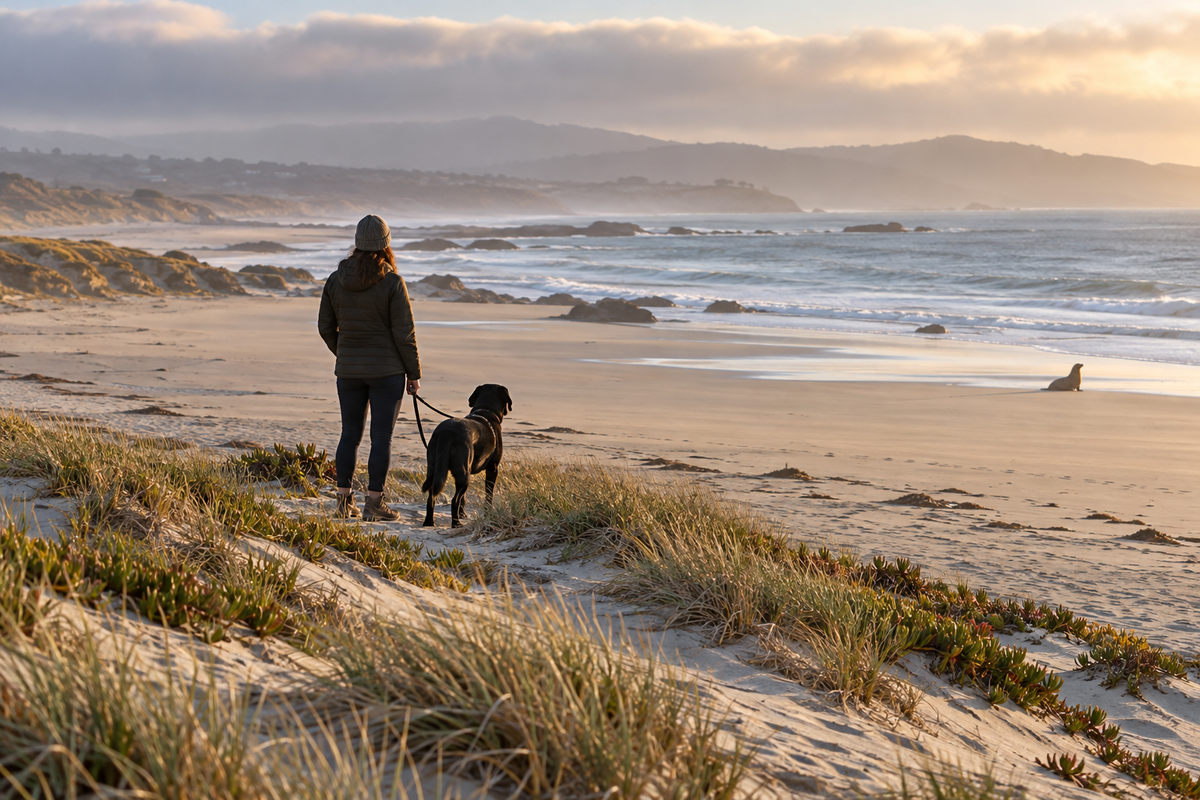
Recent sea-lion admissions from Monterey State Beach, Marina, Moss Landing, Pajaro Dunes and Carmel make one beach habit especially important: give the animal room, keep the dog close and let trained responders decide what happens next.
Direct answer: Put your dog on a leash and move at least 150 feet—or 50 yards—away from the sea lion. Do not touch, feed, move, pour water on or try to return the animal to the ocean. From a safe distance, note the exact location and condition, then call The Marine Mammal Center at 415-289-SEAL (7325).
Why does this matter around Monterey Bay now?
The Marine Mammal Center’s patient list, updated October 6, includes recent California sea-lion admissions from Monterey State Beach, Marina, Moss Landing, Pajaro Dunes and Carmel. The list does not publish a diagnosis for every new patient, so it would be wrong to assume every animal stranded for the same reason.
What is established is that the Center reported an increase in sea lions and fur seals showing signs of domoic-acid poisoning this summer, with recent cases heavily concentrated on the Monterey Peninsula. Sick animals may be stressed, disoriented and unpredictable. Other marine mammals on the beach may simply be resting.
Either way, the correct first move is the same: create distance. The animal’s appearance is not an invitation to diagnose it, and a curious dog should not become part of the assessment.
Does every sea lion on the sand need rescuing?
No. NOAA Fisheries says most live seals, fur seals and sea lions seen on shore are resting and do not need emergency care. They use land to rest, breed, nurse young, molt and avoid predators.
That is why trying to “help” by pushing an animal toward the water can do harm. It may interrupt needed rest, separate a mother and pup, worsen stress or place people and pets within reach of teeth and powerful flippers. Only trained, authorized responders should approach, handle or relocate a marine mammal.
If the animal reacts to you—by lifting its head repeatedly, vocalizing, moving away or changing its behavior—you are already too close. Back up quietly and take the dog with you.
What should you report?
The Marine Mammal Center asks callers to provide the animal’s exact location and useful observations from a safe distance. Before calling, gather what you can without approaching:
- the beach name, nearest access point, landmark or GPS location;
- whether the animal is alive, dead, injured, entangled or behaving unusually;
- its approximate size, color and whether it has visible external ears;
- obvious wounds, tags or markings; and
- a photo taken with zoom from outside the 150-foot buffer, if it can be done safely.
Along the California coast from San Luis Obispo to Mendocino, call 415-289-SEAL (7325). Elsewhere, NOAA’s West Coast stranding network map identifies the authorized local responder; its regional hotline is 1-866-767-6114.
How should you manage the dog?
Clip the leash on before judging the situation. If your dog is already leashed, shorten it without pulling the dog toward the animal. Turn around, move to an upper path or leave the beach if that is the cleanest way to preserve the buffer.
Do not use the encounter as a training exercise. Do not let the dog sniff tracks, investigate a carcass or drink nearby water. NOAA notes that sea lions can carry infections including leptospirosis, which can be transmitted to dogs and people; avoiding contact is the prudent response, not trying to determine risk by sight.
If contact occurred, move away and call your veterinarian for guidance. Urgent symptoms or an injured dog need prompt veterinary care; the Dog Help Desk can help organize the handoff but does not replace a veterinarian.
Make the next beach decision before you arrive
Check the exact land manager’s dog rules before leaving home. Many California state beaches prohibit dogs on the sand, while others allow them only on leash or in specific sections. Salt Hound’s California Dog Guide and California Dog Adventure Finder can help you choose a legal alternative, and the California Dog Hazard Center collects the larger coastal-safety picture.
A good beach walk sometimes ends with an uneventful turn in the other direction. For a resting or sick marine mammal, that quiet choice may be the most useful help you can give.
Source note: Current patient locations and reporting guidance were checked October 8, 2026, against The Marine Mammal Center and NOAA Fisheries. Conditions and patient status can change; use the linked official sources and posted beach rules.