A humpback’s unusual trip into the Bay–Delta is a timely reminder that the best wildlife encounter is often the one we do not try to improve.
Stay at least 100 yards from a whale—about the length of a football field—and never chase, surround or cut across its path. If a whale approaches your boat, kayak or paddleboard, slow down, give it a clear route and let the animal decide where it goes. From shore, use binoculars or a telephoto lens instead of launching or moving closer.
The question matters this week because an adult humpback known as Rio was reported traveling from San Francisco Bay into the Sacramento–San Joaquin Delta near Rio Vista. In a September 18 update, The Marine Mammal Center said its experts were coordinating with partners to monitor the whale and asked the public not to alter the animal’s course.
Rio’s latest location and reason for traveling inland were not established in the Center’s public update. That uncertainty is exactly why distance matters: curiosity is not a license to conduct our own assessment.
What does 100 yards look like?
One hundred yards is roughly the length of a football field. On open water, it can feel farther than expected—especially when a whale surfaces briefly and disappears.
NOAA Fisheries’ West Coast guidance tells boaters to stay at least 100 yards from whales, slow to a no-wake speed and avoid approaching head-on, from directly behind or from the side. It also says not to place a vessel between whales, particularly a mother and calf.
The 100-yard rule is a minimum viewing distance, not a goal line to patrol. If keeping that separation requires backing away, changing course or ending the outing, do it.
What if the whale comes toward you?
A whale can close distance far faster than a person expects. If that happens, do not turn the encounter into a pursuit.
Slow down. Put a motor in neutral when it is safe to do so. Keep the whale’s travel path open. Once the animal has passed, depart gradually rather than accelerating across its route. Kayaks, paddleboards and personal watercraft need the same restraint as larger boats.
The Marine Mammal Center’s guidance for Rio is especially simple: do not follow, surround or try to redirect the whale. Specialists may decide whether intervention is appropriate; spectators should not.
What should shoreline viewers do?
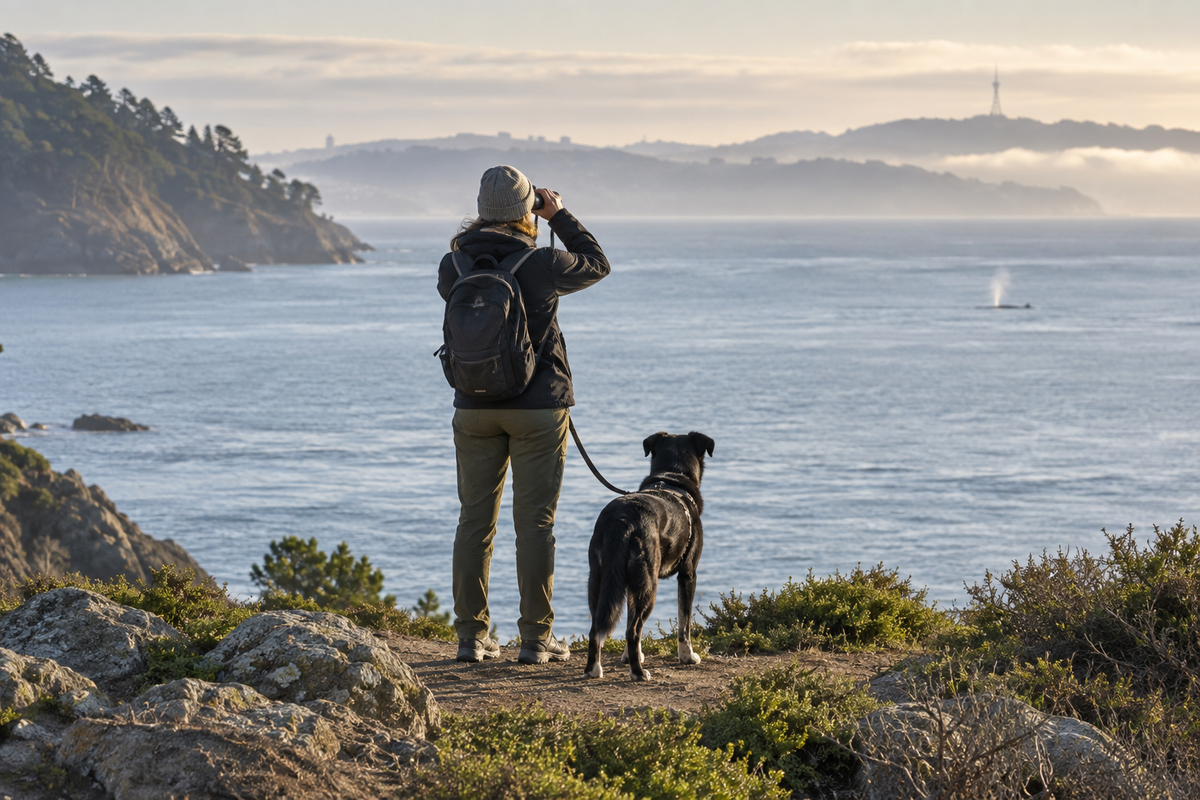
Shore is usually the easiest place to create distance. Pick a legal overlook, stay behind barriers and use optics rather than scrambling down rocks or launching a craft for a closer look. A distant spout is still a remarkable sight.
If your dog is with you, first confirm that dogs are permitted at the exact location. California State Parks says dogs in its dog-access areas must remain physically controlled on a leash no longer than six feet, and many beaches and trails do not allow dogs at all. The California Dog Guide and California Dog Adventure Finder can help you start with an appropriate outing, but current land-manager rules still control.
Keep the leash short enough to prevent a rush toward an edge or shoreline, choose a quieter viewing spot when crowds build, and leave if the dog cannot settle. Wildlife viewing does not become more responsible simply because it happens from land.
How should you report a whale?
For an ordinary sighting, The Marine Mammal Center recommends sharing the location through its reporting page or the Whale Alert app. A precise observation made from a respectful distance can help trained teams without adding another vessel around the animal.
NOAA lists separate West Coast contacts for urgent situations: report a dead, injured or stranded marine mammal at 1-866-767-6114; report an entangled whale at 1-877-SOS-WHALe (1-877-767-9425) or by VHF Channel 16 to the U.S. Coast Guard. Do not attempt to cut gear, touch the animal or improvise a rescue.
Before any coastal trip, the California Dog Hazard Center is a useful reminder that wildlife, surf, cliffs and access rules belong in the plan—not as surprises after arrival. For how Salt Hound evaluates changing rules and safety claims, see the Verified Dog Resource Standard.
The kindest sighting may look uneventful
A whale appears. You stop. You keep the dog close. You watch from where you already are.
No chase. No shortcut down the bluff. No boat angling for a better photograph. Just enough room for a wild animal to keep making its own decisions.
That is not missing the moment. Along the California coast, it is one of the best ways to deserve it.
Source note: Rio’s status and whale-viewing guidance were checked September 21, 2026, using The Marine Mammal Center, NOAA Fisheries and California State Parks. Conditions and animal locations can change; follow current agency direction.