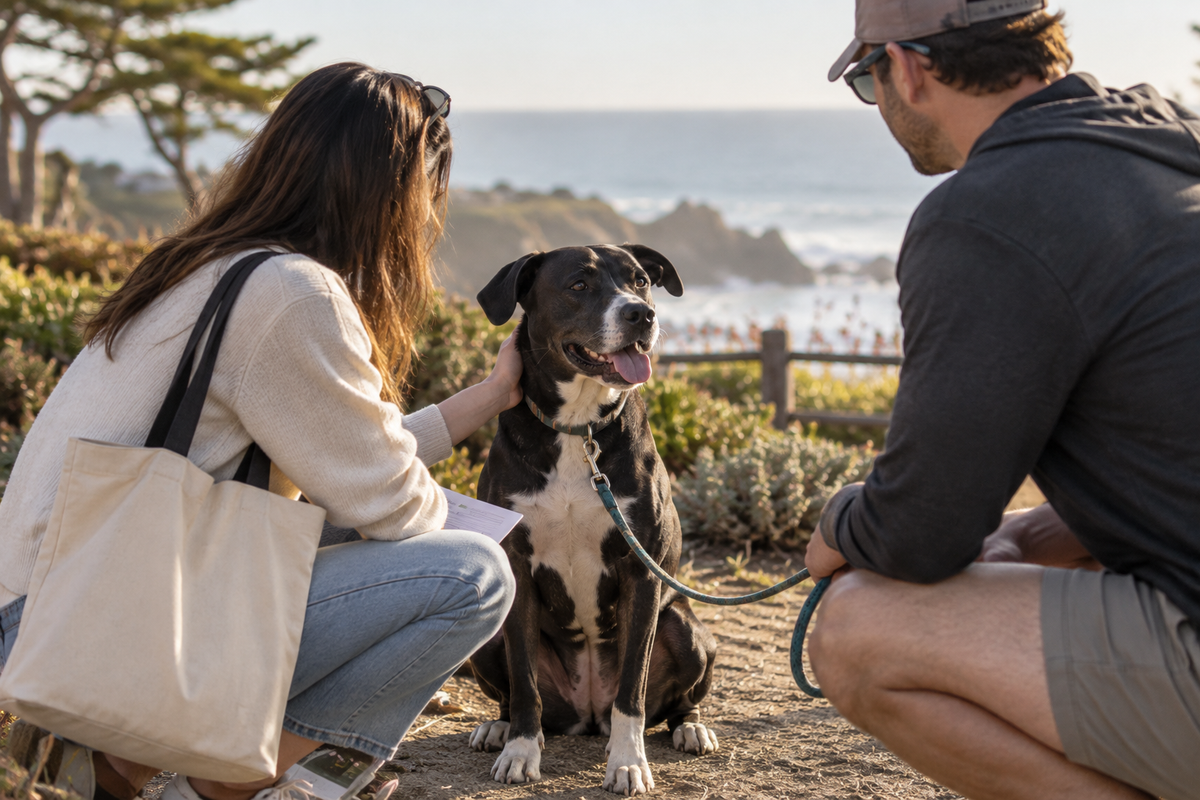
There is nothing wrong with falling for a dog quickly.
Sometimes it happens before the introduction is even finished. A face catches you. A dog leans into your leg. You start picturing the passenger seat, the morning walk and the empty corner of the living room that suddenly does not feel empty anymore.
This week, Joybound People & Pets is giving East Bay families plenty of chances for that moment, with mobile adoption events in Lafayette, Oakley and Walnut Creek, including Wish Walnut Creek on September 24. Their staff are there to help people think about fit, lifestyle and preferences—not simply whether the first five minutes feel magical.
That distinction matters.
The purpose of asking better questions is not to talk yourself out of adopting. It is to make the decision strong enough to survive the ordinary days after the adoption photo.
Ask what a normal day looks like
“Is this a good dog?” is almost useless as an adoption question.
Ask instead what the dog does on an ordinary morning. How quickly do they settle after a walk? What happens when someone knocks at the door? Do they sleep most of the afternoon or look for something to do? What have staff or fosters noticed when the dog is excited, uncertain or tired?
A dog who looks quiet at a crowded event may simply be overwhelmed. A dog bouncing at the end of the leash may be showing you excitement rather than its normal energy level.
You are trying to learn the rhythm of the dog, not judge a performance.
Ask what they know—and what they are estimating
Breed labels can sound more precise than they really are.
SPCA Monterey County notes that it does not DNA-test the pets in its care; breed designations can be based on appearance, size, behavior and whatever history is available. That is a useful reminder not to build an entire expectation around one breed name on a profile.
Ask about the individual dog instead.
What has this dog actually enjoyed? How much activity has worked well? What does the dog do after exercise? Does a long walk seem satisfying, or does the dog need more mental work and sniffing? Does activity help the dog settle, or does too much stimulation make settling harder?
That is much more useful than assuming every dog with the same breed label needs the same life.
Ask how the dog handles the boring parts
Everybody asks about beaches, hikes and other dogs.
Also ask about Tuesday.
How does the dog handle being alone? A car ride? Mealtime? Nail trims? Having paws touched? A quiet evening? Walking past another dog without greeting? Sleeping in a new place?
Those answers often tell you more about compatibility than whether the dog likes tennis balls.
Ask what veterinary care is done—and what comes next
Find out what vaccinations, parasite prevention, testing, dental care, spay/neuter care and microchipping have already been completed and what the rescue recommends next.
Then make sure the microchip registration actually follows the dog home with you. A microchip is useful only when the contact information connected to it can lead back to you; SPCA Monterey County specifically reminds owners to update that information whenever phone numbers or addresses change.
This is also where adopters should know about the help already available in their community. On September 19, Joybound is offering free vaccinations and microchips in Pittsburg, along with a FoodShare pantry for qualifying Contra Costa County residents. In Monterey County, SPCA Monterey County has a September 18 clinic with low-cost vaccines and free microchipping. Availability and eligibility vary, so check current details before relying on a program.
That kind of information should be part of adoption readiness—not something people discover after money gets tight.
Choose the veterinarian before you need the veterinarian
Do not wait for the first sick day to decide where you are going.
AAHA recommends looking at practical things such as appointment availability, emergency options, proximity, diagnostic capabilities, communication and cost. Accreditation can be one useful quality signal, but the larger goal is to know how the practice works before you urgently need it.
Ask where after-hours cases go. Ask how estimates are communicated. Ask whether you can call with a question when you are unsure something warrants an appointment.
A veterinary relationship is easier to build when nobody is panicking.
Give the first few days less ambition
A newly adopted dog does not need to meet your extended family, visit three patios, go to the dog beach and discover every room in the house by bedtime.
A quieter beginning is often more useful.
Keep meals predictable. Give the dog a reliable sleeping space. Let walks be simple. Avoid turning the first weekend into an audition for the life you hope the dog will eventually have.
You have years for adventures.
The first few days are for learning each other.
Ask one uncomfortable question
Before you leave, ask:
“What do you think could make this placement difficult?”
That question gives someone permission to tell you the part that did not fit neatly into the profile.
Maybe the dog becomes frustrated without enough enrichment. Maybe handling needs to move slowly. Maybe another dog in the home needs a careful introduction. Maybe a senior dog has ongoing medication costs. Maybe nobody knows yet because the dog only arrived recently.
None of those answers automatically means no.
Knowing is what makes planning possible.
Adoption should be emotional—and informed
Salt Hound believes every dog deserves to be chosen.
But being chosen should mean more than being taken home.
It should mean somebody asked enough questions to understand the dog in front of them, thought about the veterinarian, the food bill, the exercise, the quiet days, the unexpected expenses and the life that starts after the adoption event packs up.
Falling in love with the dog can happen in five minutes.
Building the life that keeps that dog home takes longer.
That is the part worth preparing for.