Walnut Creek’s newly approved Liberty Center points to a wider idea of rescue: helping dogs and their people stay together before a hard season becomes a permanent goodbye.
Most rescue stories begin with a dog who needs a home.
This one begins earlier.
On September 16, Joybound People & Pets announced that the Walnut Creek Planning Commission had unanimously approved plans for The Liberty Center, a future facility designed to combine everyday boarding and daycare with veterinary behavioral services, crisis boarding and disaster-response support. The project cleared the commission at its September 10 meeting; the city agenda describes a new animal-care building with outdoor training and exercise areas as an expansion of Joybound’s existing campus.
It is a local development with a larger message: sometimes the most important rescue work happens before a dog is surrendered.
A temporary crisis should not require a permanent goodbye
Dogs do not understand why a person has been hospitalized, displaced, forced to leave an unsafe home or called away by a family emergency. They only know that the routine changed and their person disappeared.
For the human, the problem can become brutally practical. Who can safely take the dog tonight? Who can manage medication, a behavioral need or a dog who does not thrive in a typical boarding environment? What happens if the emergency lasts longer than expected?
Without an answer, a temporary problem can end in permanent separation.
That is what makes crisis boarding different from ordinary convenience. It is not simply a place to leave a pet. At its best, it is a bridge: stable care while a person finds housing, recovers, escapes danger or gets through the part of life that did not arrive with a warning.
Behavior support belongs in the same conversation
Joybound’s plan also includes veterinary behavioral medicine and dedicated care for dogs whose needs may not fit traditional boarding. That matters because behavior is often treated as a private failure until it becomes a surrender conversation.
A dog who panics when left alone, struggles with handling or becomes overwhelmed around other dogs does not need shame attached to the problem. The family needs an honest assessment, a workable plan and access to qualified help before everyone reaches the breaking point.
For adopters, this is a useful question to ask before taking a dog home: What behavior support is available after adoption? Ask the shelter or rescue what it has observed, what has helped the dog settle and who to contact if a new behavior appears at home. Early support can be quieter, cheaper and kinder than waiting for a crisis.
Build your own small bridge now
A community facility can fill a major gap, but every dog household can make the first few steps easier.
Choose one backup person who knows the dog well enough to step in. Keep a one-page care note with the veterinarian, emergency clinic, food routine, medication list, microchip number, leash habits and the things that reliably help the dog settle. Store a few days of food and necessary supplies where that person can find them.
Then ask the uncomfortable question before you need the answer: if your first choice cannot help, what is Plan B?
This is especially important in California, where an ordinary family emergency can overlap with wildfire smoke, evacuation, power loss or road closures. A leash, current identification, a secure carrier or restraint, and a written care plan are not dramatic preparations. They are the pieces that let another person help quickly.
Help an older dog flourish through disruption
For a senior dog, continuity matters even more.
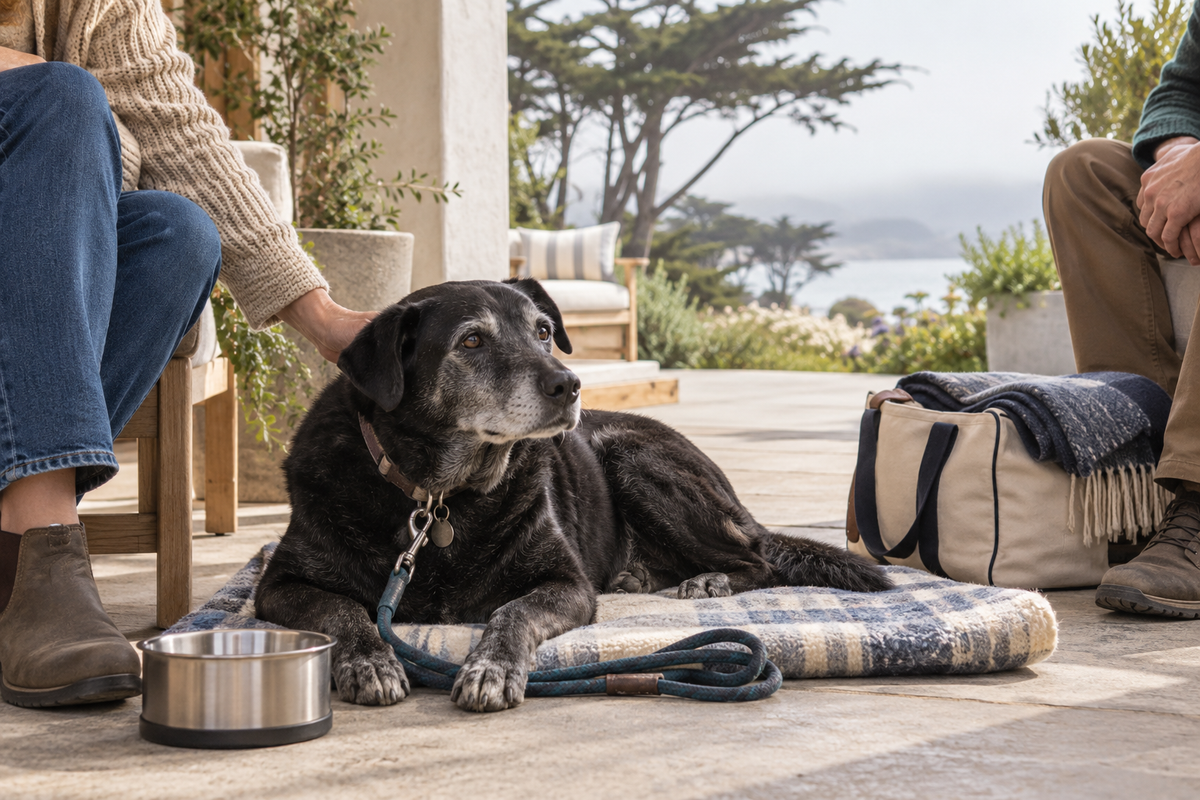
Keep the regular food clearly labeled and do not ask a temporary caregiver to improvise a new diet. Cornell’s College of Veterinary Medicine notes that nutrition for older dogs should be individualized around body condition, muscle condition, activity and health—not simply the word “senior” on a bag. Changes in appetite or weight deserve attention rather than being dismissed as normal aging.
Write down every medication exactly as the veterinarian directed, along with the clinic’s contact information; never ask a caregiver to adjust or substitute it. Pack familiar bedding, a nonslip mat if mobility is uncertain, and any harness or support aid the dog already uses. Short, comfortable movement and gentle enrichment may suit some older dogs better than an ambitious outing, but the right amount depends on the individual dog’s health and conditioning.
The AAHA senior-care toolkit encourages caregivers to monitor changes in mobility, appetite, comfort and behavior and to share concerns with a veterinarian. The practical takeaway is simple: do not make a senior dog’s care live only in one person’s memory.
Rescue is also what keeps a dog home
Adoption will always be the visible heart of rescue. It should be. A dog gets chosen, a family expands and everyone gets the photograph.
But the less visible work matters just as much: behavior care before frustration becomes surrender, temporary boarding during a crisis, disaster planning before the roads fill, and a backup person who knows where the food and medication are.
The Liberty Center is still a plan moving toward construction, not a service families can use today. But its approval gives Walnut Creek a timely reason to think bigger about what animal welfare can be.
Every dog deserves to be chosen.
And when life gets hard, every bond deserves a fair chance to hold.