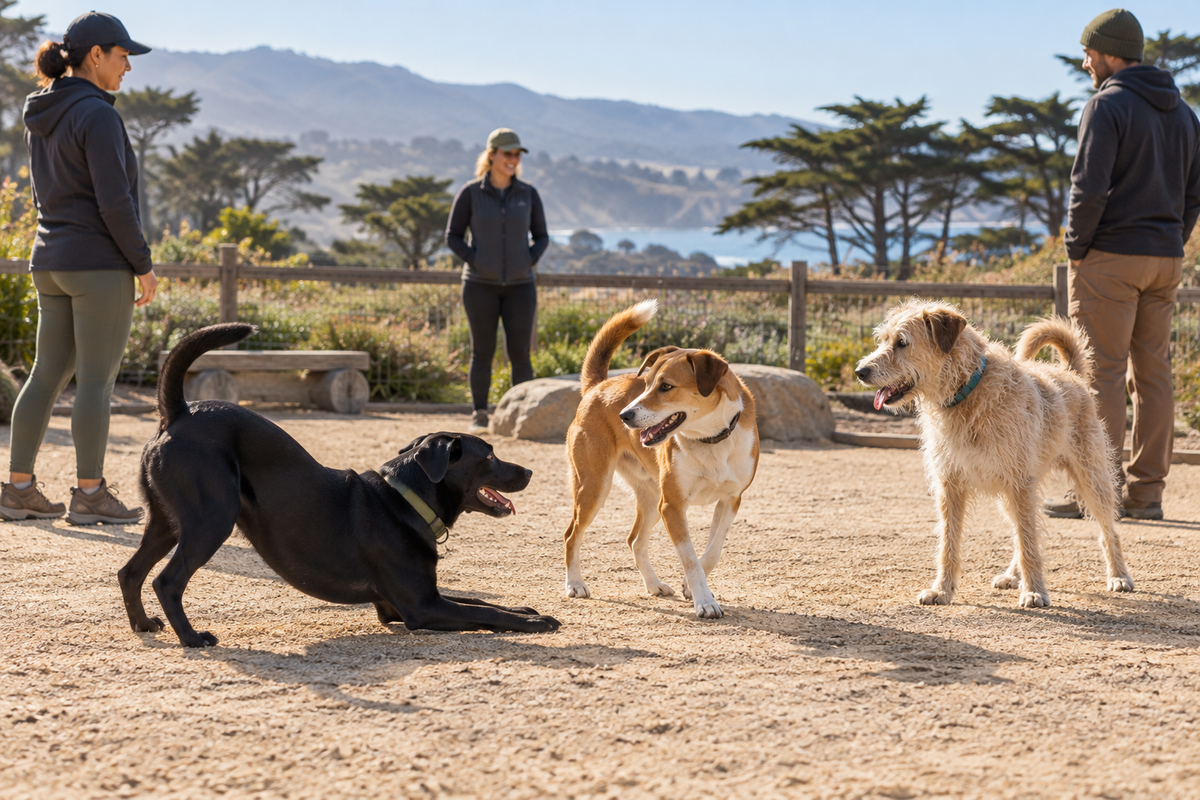
A supervised dog social can offer safer, more structured play than an open dog park—but only when the group matches the dog already standing beside you.
Short answer: A group dog social is a reasonable choice for a dog with a demonstrated history of relaxed, friendly play who can pause, disengage and respond to other dogs’ signals. It is not the right place to test whether a fearful, avoidant, highly selective or over-aroused dog can “get used to” a crowd. When a dog is unsure, a quieter walk, one compatible playmate or guidance from a qualified behavior professional is usually the more respectful starting point.
That distinction is especially useful around Monterey Bay today. SPCA Monterey County’s small-dog social is scheduled for 9–10 a.m., followed by its large-dog social from 10:15–11:15 a.m. Both are reservation-only. The shelter describes these sessions as structured alternatives to dog parks for dogs that are already comfortable meeting unfamiliar dogs and people—not rehabilitation for social difficulties.
What makes a dog a good candidate for group play?
Look at the dog’s history, not the outing you hope to create. A suitable participant has repeatedly shown that they can meet unfamiliar dogs without freezing, rushing, cornering or escalating. During play, the body stays loose rather than rigid. Movement has pauses and curves. Both dogs get chances to approach, retreat and restart.
A dog does not need to greet every dog or play nonstop to be socially capable. Calmly walking away is valuable communication. The better question is whether the dog can make and respect choices: Can they disengage? Can they take a break? Do they soften again after excitement? Can the handler call them away without turning the moment into a struggle?
The American Veterinary Society of Animal Behavior notes that relaxed dogs often show softer eyes, an open mouth and loose body tone. By contrast, stillness, a hard stare, a closed mouth or stiff posture can signal discomfort that people miss while waiting for a growl.
When should you choose something quieter?
Repeated retreating, hiding, freezing, tucked posture, stiff staring, frantic escape attempts or an inability to come down from excitement are reasons to stop—not reasons to add more exposure. Persistent chasing, mounting or ignoring another dog’s requests for space also indicate that the group may be too difficult.
Socialization is not simply exposure. AVSAB’s guidance emphasizes watching approach-versus-retreat behavior and adjusting the intensity of an experience to the individual dog. Pushing a worried dog into an overwhelming setting can deepen fear rather than resolve it.
SPCA Monterey County makes the same boundary explicit in its current social-play guidance: rough, selective, fearful, avoidant or over-aroused dogs may need a different activity. A carefully matched one-on-one play date, parallel walk or private behavior consultation can be more useful than a busy group.
What should you check before attending?
Read the organizer’s current rules rather than assuming every social operates like a public dog park. SPCA Monterey County currently requires advance reservations, a signed waiver and proof of specified vaccinations before a first visit. Its program rules also require one dog per handler unless an instructor approves otherwise, prohibit treats and toys in the play yard, and ask participants to arrive before the gate closes.
Those details serve a purpose. Removing food and toys reduces obvious competition. Matching groups by size reduces accidental injury risk. Closing the gate before play begins helps the supervisors manage arrivals instead of repeatedly interrupting the group.
If your dog is newly adopted, recovering from illness or injury, showing a recent behavior change, or has an unclear play history, ask the shelter, rescue or veterinarian what they have observed before joining a group. A sudden change in sociability also deserves veterinary attention because pain or illness can affect behavior.
What does a successful first visit look like?
Success does not have to mean an hour of constant wrestling. It might mean your dog enters calmly, shares a few loose greetings, takes breaks and leaves before becoming exhausted or irritable. Watch the dog more than the clock.
Give yourself permission to leave early. A supervised program adds informed eyes and a controlled setting, but your job remains the same: notice when your dog is comfortable, notice when that changes, and protect the option to step away.
For broader everyday guidance, visit Salt Hound’s Life Together hub. If a behavior changed suddenly or you are unsure how urgently to respond, start with the Dog Help Desk. Nobody Told Me Dogs covers the less-obvious realities of sharing life with an individual dog rather than an idealized one.
A good social is not measured by how many dogs enter the yard. It is measured by whether the dogs can communicate, recover and leave feeling as safe as when they arrived.
Source note: Event details and participation rules were checked against SPCA Monterey County on October 11, 2026. Body-language and socialization guidance was checked against the American Veterinary Society of Animal Behavior. Confirm the live reservation page and current health requirements before attending.