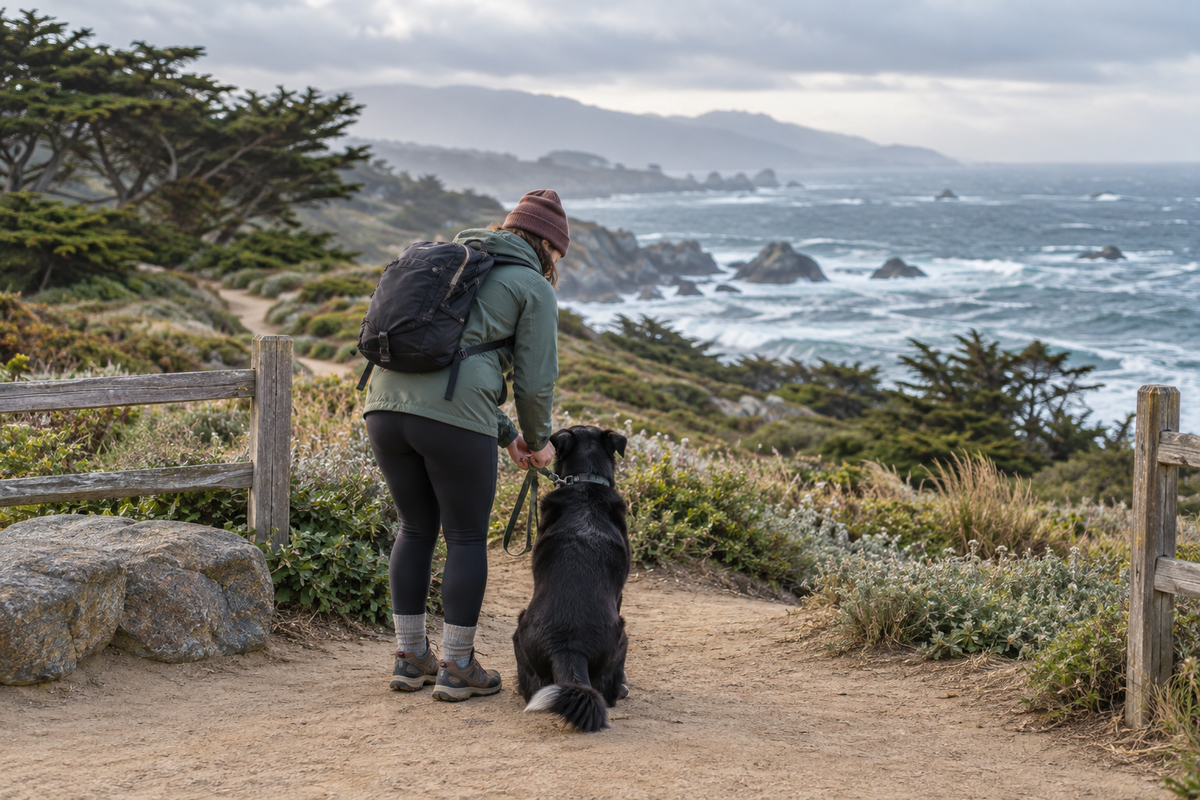
The marine forecast can look dramatic while the beach itself looks calm. Here is how to decide whether a dog outing still makes sense—and when the right call is to turn around.
Cancel a boating or paddling trip with your dog when a National Weather Service advisory covers your route, conditions exceed your experience or the vessel’s capability, or you cannot manage both the dog and an emergency safely. For a beach walk, a Small Craft Advisory is not automatically a closure; check the separate shoreline forecast, posted warnings and land-manager rules. If waves are reaching farther than expected, wind is affecting your control of the dog, or the only route uses exposed rocks or cliffs, choose a different walk.
That distinction matters along the Central California coast today. In a forecast issued at 2:22 a.m. on September 22, the National Weather Service called for stronger northwest winds this afternoon and hazardous conditions for small craft. Advisories cover coastal waters from Pigeon Point past Point Pinos and south toward Point Piedras Blancas, while the forecast notes that sheltered parts of Monterey Bay may have lower wind and seas.
Does a Small Craft Advisory mean the beach is closed?
No. A Small Craft Advisory is a marine warning for vessels, and the threshold varies by location. The National Weather Service says there is no single definition of a “small craft”; the operator’s experience and the vessel’s size, type and seaworthiness all matter.
For someone planning to kayak, paddleboard or take a small boat with a dog, that is the relevant warning. Today’s nearshore advisory from Pigeon Point to Point Pinos calls for northwest winds rising to 15–25 knots this afternoon, with seas building to 6–7 feet. South of Point Pinos, another nearshore advisory continues into the night.
A canine life jacket is sensible equipment around water, but it does not turn advisory conditions into a good dog outing. If the forecast tells inexperienced mariners to avoid hazardous conditions, taking a dog adds one more moving body to balance, secure and recover. Canceling is the clean decision.
What should beach walkers check?
Marine forecasts describe the water beyond the beach. Before a shoreline walk, check for a Beach Hazards Statement, High Surf Advisory or warning, local lifeguard information, closures and the exact dog-access rule.
California State Parks warns that large surf, cold water, backwash, sudden drop-offs, shorebreak and rip currents can make seemingly simple activities near the surf line dangerous. “Sleeper” waves can run much farther up the sand than the waves before them.
That means the safest dog walk is not the one closest to the foam. Keep the leash under control, leave a wide dry-sand buffer, stay off wet rocks and never stand where a wave could cut off the route back. If an animal or person is swept into the water, call 911 or alert a lifeguard; State Parks says only professionally trained rescuers should attempt an in-water rescue.
When is turning around the right answer?
You do not need a formal closure to decide that today is not the day. Turn around when:
- posted warnings or staff instructions conflict with your plan;
- wind makes it hard to hear, see clearly or hold the leash securely;
- waves are washing over the route, rocks or access stairs;
- fog removes the visibility your route depends on;
- your dog is frightened, over-aroused, tiring or unable to move comfortably; or
- you would have to ignore a leash rule or enter a closed area to continue.
California dog access is highly site-specific. Check the land manager before leaving home rather than assuming every beach allows dogs—or allows them on the sand.
What is the better backup plan?
A canceled coastal outing does not have to become a lost day. Move inland to a familiar neighborhood sniff walk, choose a protected paved route where dogs are permitted, or keep the adventure short and quiet. The goal is not to extract the maximum possible outing from a forecast. It is to come home with the dog safe and the coast treated with respect.
Salt Hound’s California Dog Hazard Center covers coastal risks worth checking before departure. Use the California Dog Guide for responsible access, the California Dog Adventure Finder to choose a better-fit outing, and the Dog Help Desk if something has already gone wrong and you need the next safe step.
The best coastal instinct is not bravado. It is noticing when conditions have changed—and being willing to change the plan with them.
Source note: Conditions and access guidance were checked September 22, 2026, using the National Weather Service Central California coastal waters forecast, the NWS marine advisory definitions, California State Parks ocean-safety guidance and the California State Parks dog-access directory. Forecasts and restrictions can change; check the exact site again before leaving.